No-Heat Help for Furnaces and Boilers in Minneapolis
When a furnace or boiler quits in the middle of a Minneapolis winter, a few safe checks can sometimes bring the heat back. When they do not, the next step is an urgent service request.
If the house is already getting cold, send a no-heat request now and work through the checks while you wait, or call and describe what is happening.
No-Heat Troubleshooter
Each answer leads to the next check, from the thermostat to the vent pipes outside. Every check stays on the outside of the equipment: no panels come off.
Press “Start the Checks” for the first question.
No-Heat Symptoms and Safe Checks
A furnace or boiler that has stopped usually still gives clues: a blank thermostat, a blower that runs cold, a breaker that will not stay on. Each clue narrows the search, and most have a check that is safe to make without opening anything.
| Symptom | Likely area | Safe homeowner check | When to stop and call |
|---|---|---|---|
| The thermostat screen is blank | Dead batteries, or no power at the furnace or boiler | Fresh batteries; check the breaker and the power switch | Still blank with fresh batteries and the power on |
| The blower runs, but the air is cold | Burners not lighting (igniter, flame sensor or gas supply), or the fan set to On | Set the fan to Auto; check the filter | Still cold after several minutes on Heat with the fan on Auto |
| The furnace lights, then shuts off after a short run | A clogged filter, a dirty flame sensor or a blocked vent pipe | Change a dirty filter; clear the vent pipes outside | It keeps cycling with a clean filter and clear pipes |
| The furnace is completely silent | No power: the breaker, the power switch, or a loose front panel and its safety switch | Check the breaker and the switch; press the front panel into place without removing it | The power is on and still nothing happens |
| The boiler runs, but the radiators stay cold | The circulator pump, air in the pipes, low water pressure or a zone valve | Check that zone’s thermostat; note the pressure gauge reading | The gauge is far from its usual mark, the pump is silent, or the relief valve drips |
| Water on the floor near the equipment | A condensate drain or pump on a high-efficiency furnace; a valve on a boiler | See that the condensate pump is plugged in and its hose is in place | Water keeps coming, or it is near wiring or controls |
| A bang or rumble as the burners light | Delayed ignition, often from dirty burners or a gas pressure problem | None: set the thermostat to Off | Right away, before it runs again |
| The breaker trips when the furnace starts | A failing motor or a wiring fault | Reset the breaker once | It trips a second time |
When the Problem Is Inside the Furnace or Boiler
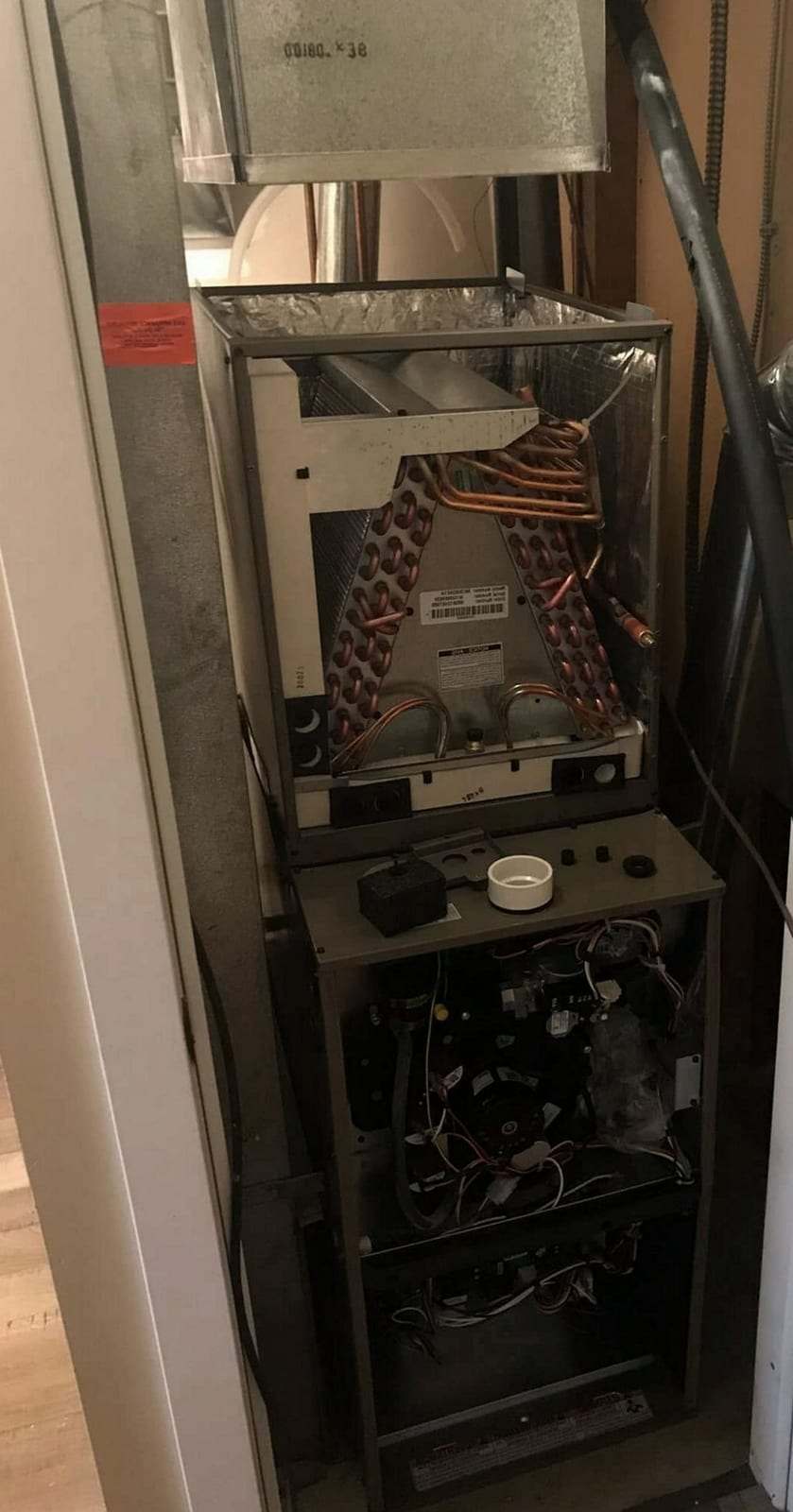
Once the thermostat, the power, the filter and the vent pipes check out, the cause is usually inside the cabinet. On a furnace, that can be a failed igniter, a dirty flame sensor, a pressure switch, the inducer or blower motor, or the control board. On a boiler, it may be the igniter, the circulator pump or a zone valve.
Those parts sit next to gas valves and high-voltage wiring. Restarting a furnace again and again, or resetting a safety switch that keeps tripping, can hide the very problem the switch is there to catch.
Bryn AC & Heating handles furnace and boiler repairs, from no-heat calls to failed igniters. A note of what the equipment did and which checks you made gives the technician a head start.
Details to Gather for a No-Heat Request
Have these on hand when you call or fill in the request form:
- Furnace or boiler, and the brand and model if the label can be read without removing a panel
- What the thermostat shows: the setting, the room temperature and any message
- What the equipment does: nothing, clicks, runs without heat, or starts and stops
- How a status light blinks, if the furnace has a small window that shows one
- Which safe checks you have made, and whether anything changed
- How cold the house is, and whether an infant, an older adult or someone ill is at home
- Where the equipment is and how to reach it, such as a tight mechanical room or a locked boiler room
- For a rental or an apartment building, who can let the technician in
Keeping People and Pipes Safe in a Cold House
While the heat is off, keep the warmth you have: close the doors to rooms you are not using, keep the curtains closed and gather in one room with a safe electric heater. Never heat the house with a gas oven or range, a grill or a generator, which can fill it with carbon monoxide.
Water pipes are the other risk. A pipe on an outside wall can freeze and split in a cold house, and the damage often shows only when it thaws. Find the main water shutoff now, before it is needed.
Questions About Heaters, Frozen Pipes and CO Alarms
Is it safe to use a space heater while the furnace is out?
Use an electric heater with a tip-over switch and overheat protection. Plug it straight into a wall outlet, not an extension cord or power strip, and keep bedding, curtains, furniture and anything else that can burn at least three feet away.
Turn it off when you leave the room or go to sleep. Camp and patio heaters that burn fuel belong outside.
Which pipes freeze first, and what can I do about it?
Pipes on outside walls, in unheated porches, garages and crawl spaces, and under sinks on exterior walls cool fastest. Open the cabinet doors under those sinks and let a faucet on an outside wall drip slowly.
A faucet that gives only a trickle may have a frozen pipe behind it. Leave it open and warm the pipe gently with a hair dryer, never an open flame. If a pipe splits, close the main water shutoff and call a plumber.
What should I do when a carbon monoxide alarm goes off?
Treat it as real. Get everyone outside into fresh air, call 911 from outside, and stay out until the fire department says the building is safe. Do not stop to look for the cause.
Tell the dispatcher if anyone has a headache, dizziness, nausea or confusion. After the all-clear, have the furnace, boiler and other fuel-burning equipment checked before they run again.
Why does my carbon monoxide alarm chirp every minute or so?
A single chirp at regular intervals usually means a low battery or an alarm at the end of its life. The alarm itself is a loud, repeating pattern of beeps, and the label on the back explains the signals. If you are unsure which one you hear, treat it as an alarm and go outside.
Catching Worn Parts Before Winter
No-heat problems often start with parts that wear slowly: igniters, flame sensors and filters left in too long. A fall tune-up with burner cleaning and safety checks on the heat exchanger and venting is the usual way to catch them before the heating season starts.
If the checks did not bring the heat back, send a request with what you found, or call and say the heat is out.